Follow this link to sign up for events!

Returns on investing in solar has banks and investors funding distributed solar

SLevy: Distributed solar is disruptive to electric distributors, especially in regions with high power rates. Solar will accelerate installations, a fact that must be factored into the future business plans of our distributors here in the valley. To support this statement Edison Electric Institute recently published a report entitled “Disruptive Challenges: Financial Implications and Strategic Responses to a Changing Retail Electric Business.” TSEA offers distributors its services in understanding the impact and has suggestions towards solutions to avoid faced with unpleasant alternatives.

There were a record number of solar panels installed in the U.S. on rooftops and on ground-mounted systems in 2012. Now both traditional financing companies and new types of investors are starting to get in on the trend of providing the funds for the high upfront costs of installing solar panels, in exchange for making some money back several years down the road. But the potential to make money in this way has only just started.

Solar leases are a contract between the building owner and SolarCity, whereby SolarCity pays the upfront cost of installing the system, owns and maintains the panels, and the building owner pays for the monthly electricity for the power from the panels over around 20 years. As Ucilia noted on GigaOM Pro today, the residential solar leasing market alone is expected to grow from $1.3 billion in 2012 to $5.7 billion in 2016, according to GTM Research.

SunPower said earlier this month that demand for its residential solar leases is far greater than the money available to finance them.

It’s not just banks and corporate do-gooders that want the opportunity to make a decent return — some 10 to 12 percent in some cases. Crowd-funding is starting to appear as an interesting blip on the radar. Startup Solar Mosaic says that it’s now raised $1 million from its crowd-funders for its solar panel systems, which offer around a 4.5 percent annual yield.

original article

A Second California City Establishes a Solar Mandate

SLevy: The price of electric power in parts of California is as high as 35 cents per kilowatt-hour. A strong motivation for solar whereas Tennessee has a lower price of electricity at the present. The motivation here in Tennessee is improved air quality and a buffer against future costs with other forms of electric power generation.

The town of Sebastopol, in the apple- and grape-growing rolling hills of western Sonoma County, is following suit with a much more aggressive ordinance, suggesting that solar-by-fiat might be more viable as policy. In Sebastopol, a system would also qualify if its output meets three-quarters of the building’s electrical load on an annual basis. The ordinance also includes a provision that allows officials to exempt buildings from the requirement if a site isn’t conducive to solar, but a fee or other energy-saving measures could be required.

Mayor Michael Kyes told the Press-Democrat in nearby Santa Rosa that Sebastopol, with a population of around 7,500, already had some 1.2 megawatts of installed solar capacity. “This ordinance will add to it,” the mayor said. According to the Press-Democrat, there was a citizen objection to the solar requirement registered at the Sebastopol Council meeting; someone said “mandatory sort of implies coercion” (a sentiment it’s hard to argue with). But of course all manner of building requirements are essentially coercive, and Councilman Robert Jacob seemed to capture the sentiment of the town leaders when he said that “this ordinance is not only cost-saving…it’s the responsible thing to do.”

original article

Why is SunPower Doing So Well While Others Fail?

SLevy: Every solar investor wants to maximize its return on investment. In my judgement the reason for Sun Power’s success is they provide a product with the greatest return on investment over the long term. What I mean by long term is tens of years and beyond. Their panels produce the highest output power per area of any other manufacturer. We know that the life of the premiere monocrystalline panels is beyond 40 years. Using 40 years in computing the Levelized Cost of Energy results in more realistic results in cost per kilowatt-hour.

PV energy provider (PVEP) SunPower has revealed that demand exceeded its ability to supply product and services in the first quarter of this year.

The PVEP reported that it had exceeded revenue, gross margin and earnings forecast for the first quarter of 2013, while generating significant free cash flow of US$216 million, including lease financing, which was sold out in the quarter.

SunPower noted that due to several massive PV power plant projects in full swing in the US, strong demand for lease financing rooftop business in the US and ongoing PV module partnership success in Japan that was set to continue throughout the year, it was sold out for the year.
Management noted that its project development business was on course to provide US$3.5 billion in revenue and approximately US$1 billion in gross margin from 2013 through 2016.
Importantly, SunPower said that during the first quarter, the company was awarded 65MW of rooftop projects in France during a recent tender process, which had been supported by majority company owner, Total.

With demand increasing, SunPower said that it increased cell production in the quarter to 208MW, up 36% from the previous quarter. SunPower recognised 172MW of sales, while it shipped 186MW. Total module production capacity remained at 1.2GW. Full capacity was expected to be reached in the second half of the year.

original article

The level of carbon dioxide reached a concentration not seen on the earth for millions of years.

Scientific instruments showed that the gas had reached an average daily level above 400 parts per million — just an odometer moment in one sense, but also a sobering reminder that decades of efforts to bring human-produced emissions under control are faltering.

The best available evidence suggests the amount of the gas in the air has not been this high for at least three million years, before humans evolved, and scientists believe the rise portends large changes in the climate and the level of the sea.

Carbon dioxide rises and falls on a seasonal cycle, and the level will dip below 400 this summer as leaf growth in the Northern Hemisphere pulls about 10 billion tons of carbon out of the air. But experts say that will be a brief reprieve — the moment is approaching when no measurement of the ambient air anywhere on earth, in any season, will produce a reading below 400.

“It feels like the inevitable march toward disaster,” said Maureen E. Raymo, a scientist at the Lamont-Doherty Earth Observatory, a unit of Columbia University.

original article

REAP funding of $70 million annually through fiscal-year 2018

Solar PV for farming

note from SLevy: At this moment TVA is no longer accepting applications for its Green Partners program for this year. The alternative for installers is to:
1. look for work out of state
2. look for niche applications which could include: agriculture, highway signs, corrosion protection, outdoor displays, medical equipment support, mobile emergency power support, military installations and developers who want to sell solar assisted homes without TVA support.

U.S. Sens. Al Franken, D-Minn., and Tom Harkin, D-Iowa, introduced energy legislation on Monday to be included in the 2013 Farm Bill.

According to Franken, the Rural Energy Investment Act will help farmers, ranchers and rural communities by encouraging the growth of agricultural energy technologies, including biofuels and renewable energies.

The proposal includes the Rural Energy for America Program (REAP), which Franken included in the 2012 Farm Bill that passed the Senate. Franken says the program helps agriculture producers and businesses in rural areas invest in energy efficiency and renewable energy projects so they can cut electricity bills and earn additional income by selling the energy they produce.

original article

Solar farm project launches in Kingston, TN

PHOTO BY BOB FOWLER

KINGSTON — This city is getting into the solar power business, and it’s not costing taxpayers a dime, Mayor Troy Beets said.

In a cooperative venture with a Nashville company, 200 solar panels are being installed behind the city’s water treatment plant on Highway 58 South, the mayor said after a brief ceremony Tuesday at the facility.

Another 800 panels will be put in place in July on a 1.38-acre tract of city-owned land off James Ferry Road near the plant.

“Our only skin in the game is the property,” Beets said.

Combined, the 1,000 panels should generate the equivalent of enough electrical power to operate the water treatment plant, which has about a $6,000-a-month electric bill.

Full Article

New Music City Center Solar Project

LightWave installs 211 kW Solar on New Music Center

Construction on the $585 million facility began in January 2010 and was completed on April 30, 2013. The Music City Center totals 2.1 million square feet, double the space available in the current convention center. Already more than 100 meetings and 800,000 room nights have been booked.

Project completion will be celebrated on May 19 and 20 at the Music City Center Grand Opening with Nashville Mayor Karl Dean. Celebration includes open house tours, free street party and concert featuring Sheryl Crow, The Time Jumpers with Vince Gill, Fisk Jubilee Singers, and more. Major Dean will give his State of Metro address on Monday, May 20 at 10 a.m.

LightWave Solar recently completed the installation of a 211 kilo-watt (kW) solar system for the Music City Center, and it is the largest solar installation in Nashville.

Installed within the guitar shaped structure on the roof, the system consists of 845 solar panels and four inverters weighing 1,800 pounds each. The system will generate approx. 271,000 kilowatt-hours per year, enough electricity to power the electric vehicle charging stations and lighting for the building. Over 25 years, the clean electricity will offset nearly 5,000 tons of carbon dioxide emissions, the equivalent of taking 920 cars off the road.

original release

FREE WEBINAR: Best Practices for Effective Energy Efficiency Program Design: From Strategy to Savings

DATE: Wednesday, May 15, 2013
TIME: 1:00 PM ET/10:00 AM PT  

Please join Nexant, Greentech Media, PacifiCorp, and Santee Cooper as we discuss best practices for effective energy efficiency program design, including utility program case studies.  The changing landscape of demand side management (DSM) energy efficiency programs requires utilities to leverage a combination of industry best practices and innovation in technologies to successfully plan, design and deploy DSM programs.  Join us for this one hour webinar to learn about: 
· Effective DSM program design and why it is important
· Defining a program’s success while identifying barriers and challenges in the marketplace
· Meeting compliance requirements and energy savings goals
· Managing increasingly complex programs in a cost-effective manner
· Improving customer and trade ally engagement, satisfaction and participation

Registration Fee: Free

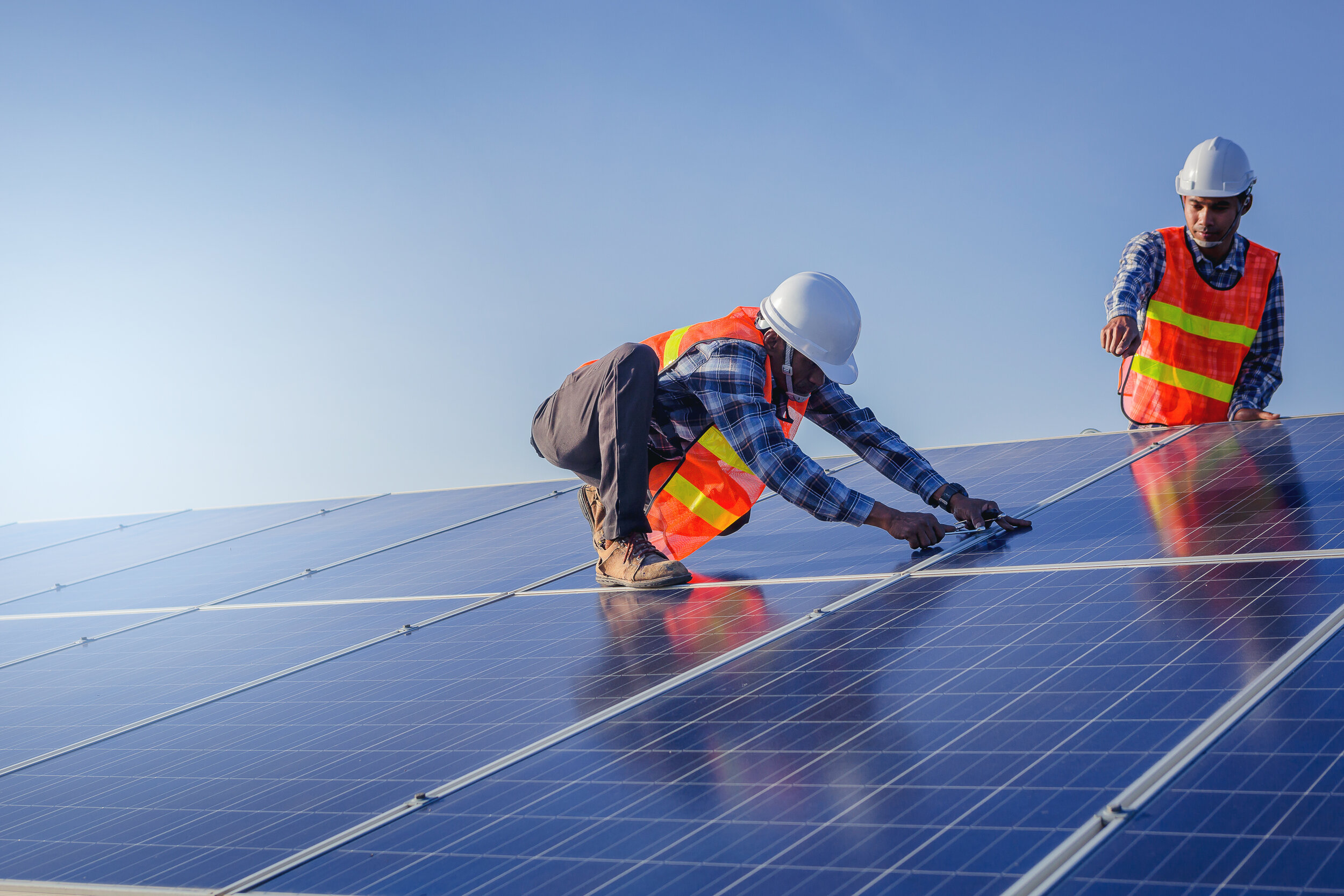
Many types of professions install solar systems

There is the belief that solar installations are limited to a few companies that only deal in solar. That is not the case as illustrated by the following article that describes the various occupations involved in solar construction.

The primary industry begins with solar contractors, and then branches out to electrical contractors and plumbing contractors. General contractors and roofing contractors are also involved in solar installations. Because solar PV is electrical and solar hot water is plumbing-related, the industry sees a lot of participation from plumbing and electrical contractors.
Solar contractors operate independently or in conjunction with other contractors, such as roofers. Every project is different, so who is involved depends on the size and scope of a project. A typical solar contractor can handle a small residential system from start to finish. A large utility-scale project may involve coordinating with a roofing manufacturer or general contractor.
Companies in this sector employ many electricians, but also plumbers, roofers and general construction labor. Given that every project has unique characteristics, every project requires a slightly different skill set. For photovoltaic, the main skill set is electrical. For larger scale projects, a need for steel or concrete professionals or roofers may present itself.The first step to any installation project is engineering, followed by permitting and procurement and installation.

the original article

With so many occupations associated with solar installations the job market is wider in scope than most people realize. Tennessee has enough sunlight to warrant adopting solar both for large farms and distributed solar within our communities. With the price for large installations at prices competing with fossil-fueled power generation, with the advantages of no fuel cost and the environmental benefits – what is stopping our national leaders from promoting this technology? That is a question that only they can answer.

Prices for Natural Gas are Going Up and New Drilling Goes Down

Electric Utilities May Be Disappointed with Gas Prices